8 Week 7- Population Structure & Sea Cucumbers
We will be using data from a paper by Xuereb et al. (2018) paper on P. californicus titled “Asymmetric oceanographic processes mediate connectivity and population genetic structure, as revealed by RADseq, in a highly dispersive marine invertebrate (Parastichopus californicus)”. More information on the paper and it’s findings are in the lecture slides here: Week 7 Slides

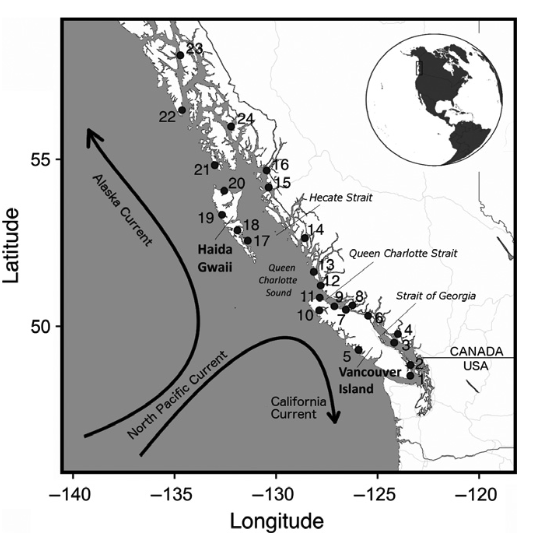
SNP data from this study will be used today in order to learn how to identify population structure in sea cucumber populations and make structure plots using tess3r and pophelper. This data is SNP data from 15 individuals per site across 7 collection sites:
8.1 Main Objectives:
- Learn what a structure plot is and how it can give us useful information on population structure in our dataset
- Learn how to make a structure plot using tess3r and pophelper
- Practice moving from terminal to R when working with big data
8.2 Download the data in terminal
We first need to download the data in terminal. So navigate to your directory and do the following command to get the vcf file we need onto your farm desktop. I got the data from the dryad (data repository) for this paper and zipped it to be more easily downloaded: https://datadryad.org/dataset/doi:10.5061/dryad.db6177b
cd /group/rbaygrp/eve198-genomics/yourdirectory
wget https://raw.githubusercontent.com/mlarmstrong/IntroGenomics_Data/main/week7.zip
Unzip the week7 directory and navigate inside. There should be three files: a vcf file (with our genetic data), a csv file (with our samples and coordinate data) and a README.txt file. The README.txt gives you information on the dataset you just downloaded. The .csv file in this folder is our metadata, with coordinates for each of our sample sites along with sample names. This will be useful for understanding population structure between populations and across space!
8.3 Moving to R:
Now we will move to R! We will need quite a few packages today since we
will be using tess3r to identify population structure and then
pophelper to visualize that structure in a more organized way. We also
need to be able to read in a vcf file, so vcfR is a useful package for
that. adegenet() is a package that will help us do additional analyses
on our genetic data.
8.4 Installing Packages
Remember that you first need install.packages() and then use
library() to load each package! This can be done for ggplot2 and
vcfR. The package devtools will also be used to install tess3r.
#>
#>    *****       ***   vcfR   ***       *****
#>    This is vcfR 1.15.0
#>      browseVignettes('vcfR') # Documentation
#>      citation('vcfR') # Citation
#> ***** ***** ***** *****#> Warning: package 'ggplot2' was built under R version 4.4.1#> Loading required package: usethis#> Warning: package 'usethis' was built under R version 4.4.1You will need to use
devtools::install_github("bcm-uga/TESS3_encho_sen") to install
tess3r(). After you have loaded each package you can get more
information on each of them by doing ?tess3r(). For pophelper() you
will need to install dependencies first with
install.packages(c("ggplot2","gridExtra","label.switching","tidyr","remotes"),repos="https://cloud.r-project.org")
then install pophelper
remotes::install_github('royfrancis/pophelper'). This might take a
while!
#> pophelper v2.3.1 ready.8.5 Set Working Directory
Now that we are working with downloaded data it is important to set your
working directory in R so you know where to store your files. I would
recommend just saving your script and all of the data for today into
your week6 directory in your named directory. To set your working
directory you can do the following:
setwd("~/where/you/are/storing/data/week7")
If you click the files tab on the right you should be able to see all of the files in your working directory too!
8.6 read vcf file
Now let’s read in our data! This will take a second and you will get information on the file in your console as it is read in. The number of variants that are processed should be 2,719. Then you can extract the genotypes with the second line of code.
#> Scanning file to determine attributes.
#> File attributes:
#>   meta lines: 9
#>   header_line: 10
#>   variant count: 2719
#>   column count: 726
#> Meta line 9 read in.
#> All meta lines processed.
#> gt matrix initialized.
#> Character matrix gt created.
#>   Character matrix gt rows: 2719
#>   Character matrix gt cols: 726
#>   skip: 0
#>   nrows: 2719
#>   row_num: 0
#> Processed variant 1000Processed variant 2000Processed variant: 2719
#> All variants processedIf you do head(genos_raw) you can see that the format is 0/0 or 1/1
for homozygotes and 0/1 for heterozygotes. We actually want to convert
this to instead be 0 for homozyous reference, 1 for heterozygotes and 2
for homozyogous alternate. To do this, you can run the following code:
## Replace genotype codes with numeric values
genotypes_cleaned <- as.matrix(apply(genotypes_raw, c(1, 2), function(x) {
  if (x %in% c("0/0", "0|0")) return(0)    # Homozygous reference → 0
  if (x %in% c("0/1", "1/0", "0|1", "1|0")) return(1)  # Heterozygous → 1
  if (x %in% c("1/1", "1|1")) return(2)    # Homozygous alternate → 2
  return(NA)             # Handle missing or other cases
}))
Check to see that it worked by doing View(genotypes_cleaned) or
head(genotypes_cleaned). The genotypes should be coded as 0, 1 or 2.
Finally let’s check the dimensions of our genotype data. The number of
individuals should be on the left and the genotypes should be on the
right.
#> [1] 2719 717It looks like it is actually flipped, so let’s fix that! The command
t() will help us transpose our data
#> [1] 717 27198.7 read in the metadata
Now let’s read in the coordinate data for our sample sites! We will also
make an object “coordinates” to hold our lat/long data for the tess3
object later. Our sites.data should a length of 717 to match our
genotype data.
sites.data<-read.csv('strata.cucumbers.717ind.csv', header=TRUE, sep=",")
coordinates<-as.matrix(cbind(sites.data$LAT, sites.data$LONG))
dim(sites.data)
#> [1] 717 58.8 population structure with tess3r
You can learn more about this package on their tutorial page (https://bcm-uga.github.io/TESS3_encho_sen/articles/main-vignette.html), but in short tess3 is a function that computes population structure by estimating ancestry proportions and ancestral allele frequencies. In the code below: - X argument refers to the genotype matrix - coord argument the coord argument corresponds to the geographic coordinates - K is the number of clusters or ancestral population - reps is the number of replications for cross validation that we are calling the ancestry correctly for each sample
Normally we would want multiple reps to ensure things are being calculated correctly, but for class we will only do 2.
tess3.cukes <- tess3(X=genotypes, coord =as.matrix(cbind(sites.data$LAT, sites.data$LONG)), K=1:8,
                     ploidy=2, lambda=0, keep="best",rep=2)
#> == Computing spectral decomposition of graph laplacian matrix: done
#> Main loop: done
#> == Computing spectral decomposition of graph laplacian matrix: done
#> Main loop: done
#> == Computing spectral decomposition of graph laplacian matrix: done
#> Main loop: done
#> == Computing spectral decomposition of graph laplacian matrix: done
#> Main loop: done
#> == Computing spectral decomposition of graph laplacian matrix: done
#> Main loop: done
#> == Computing spectral decomposition of graph laplacian matrix: done
#> Main loop: done
#> == Computing spectral decomposition of graph laplacian matrix: done
#> Main loop: done
#> == Computing spectral decomposition of graph laplacian matrix: done
#> Main loop: done
#> == Computing spectral decomposition of graph laplacian matrix: done
#> Main loop: done
#> == Computing spectral decomposition of graph laplacian matrix: done
#> Main loop: done
#> == Computing spectral decomposition of graph laplacian matrix: done
#> Main loop: done
#> == Computing spectral decomposition of graph laplacian matrix: done
#> Main loop: done
#> == Computing spectral decomposition of graph laplacian matrix: done
#> Main loop: done
#> == Computing spectral decomposition of graph laplacian matrix: done
#> Main loop: done
#> == Computing spectral decomposition of graph laplacian matrix: done
#> Main loop: done
#> == Computing spectral decomposition of graph laplacian matrix: done
#> Main loop: doneThis will take a second since it is real genomic data! We started with 8 clusters.
Next to make a structure plot, we need to first call the data and assign how many K “clusters” we want. For example, if we want to assign 8 clusters we would run the following:
#now the barplot
barplot(cukes.matrix, border = NA, space = 0,
        xlab = "Individuals", ylab = "Ancestry proportions",
        main = "Ancestry matrix") -> bp
#> Use CreatePalette() to define color palettes.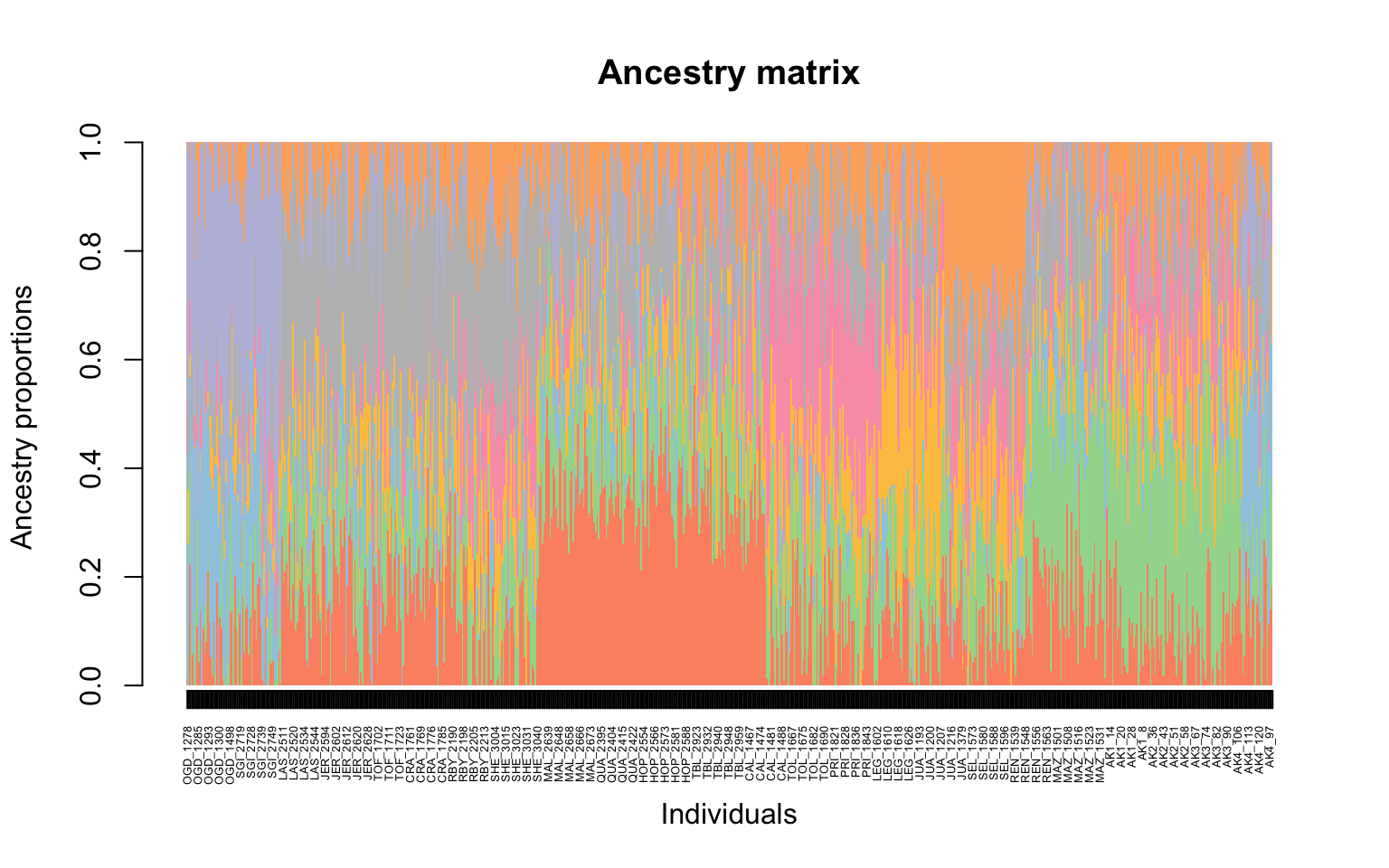
Yay our first structure plot! It isn’t ordered by site though and it is not as easily interpreted for why different individuals might vary.
8.9 But how do we know which K to pick?
In order to get an accurate estimate of the “best” K for our data we first need to run a larger range of K, here 1:8, and then look at our data and see how the cross-validation score compares to the number of predicted ancestral populations. We can do that with the code below:
The plot function generates a plot for root mean-squared errors computed on a subset of loci used for cross-validation:
plot(tess3.cukes, pch = 19, col = "orange",
     xlab = "Number of ancestral populations",
ylab = "Cross-validation score") 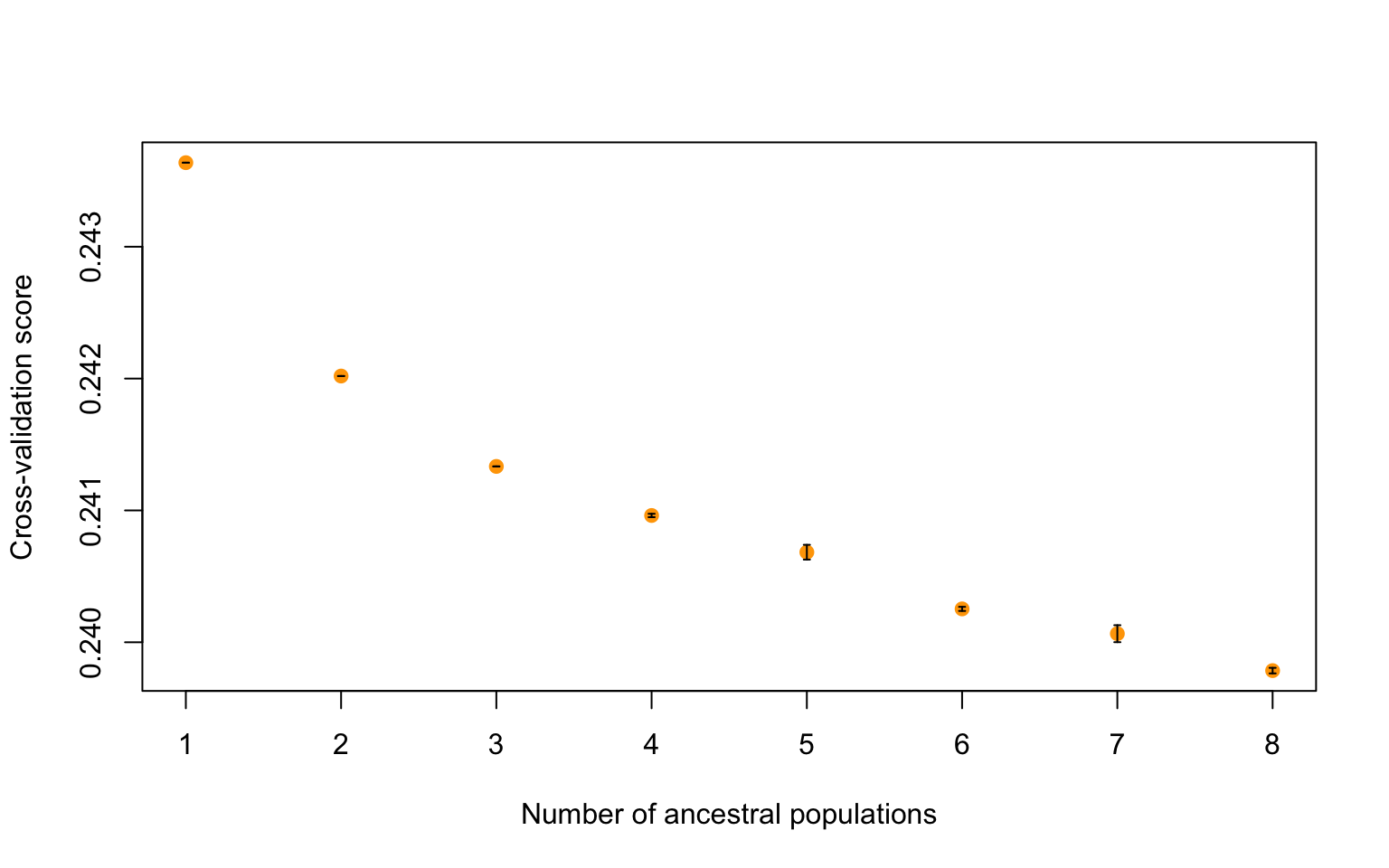
Class Exercise 1
Where the cross-validation score drops is which K is likely the best fit. Which K do you think is the best fit for our data? Let’s plot a couple different structure plots (K=2, K=4 and K=6) for data visualization and determine the best K. You can modify the code above by changing the K value and rerunning the plots.
Now that we have determined the best K for our dataset, let’s visualize things!
8.10 Visualizing population structure with pophelper!
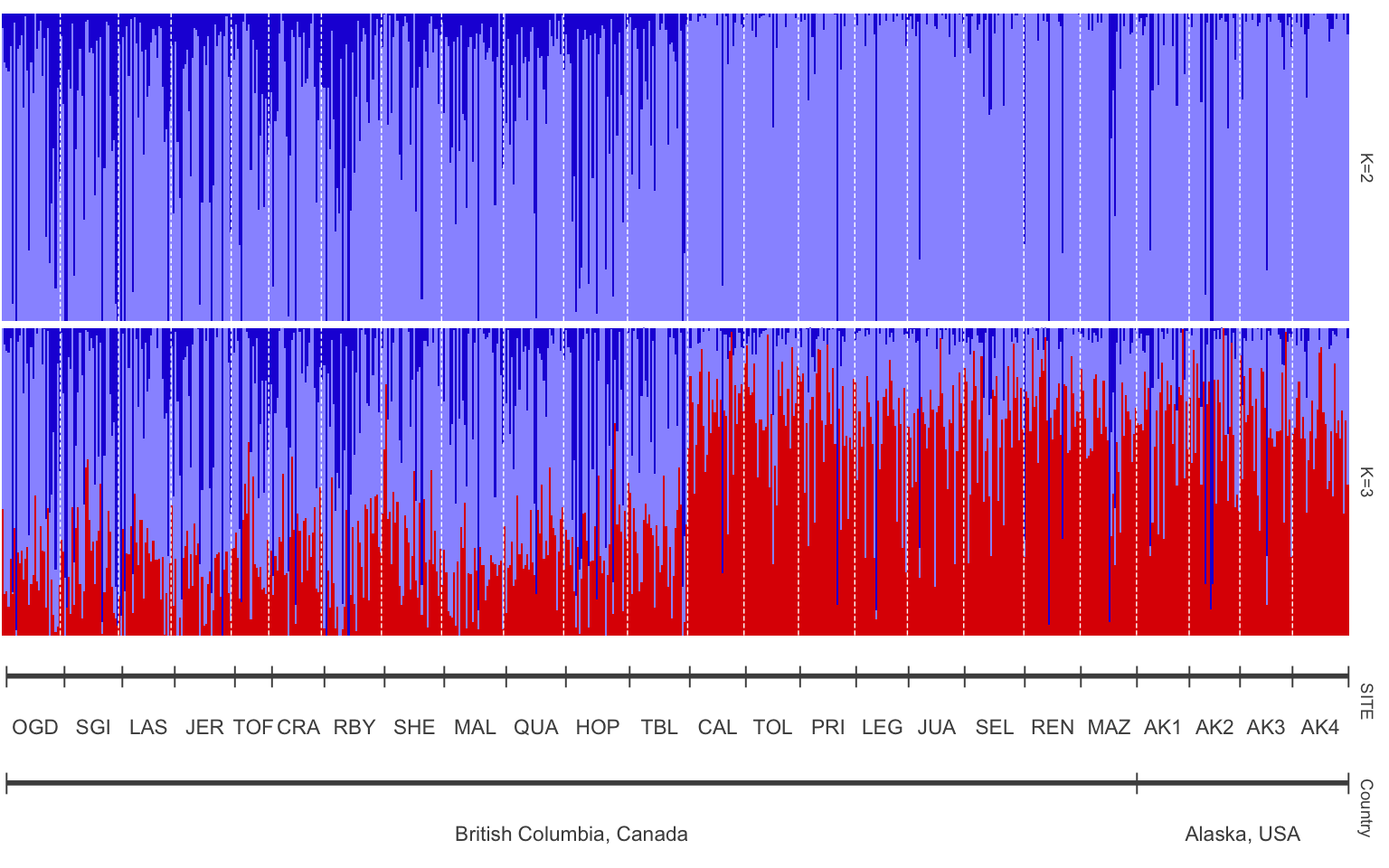
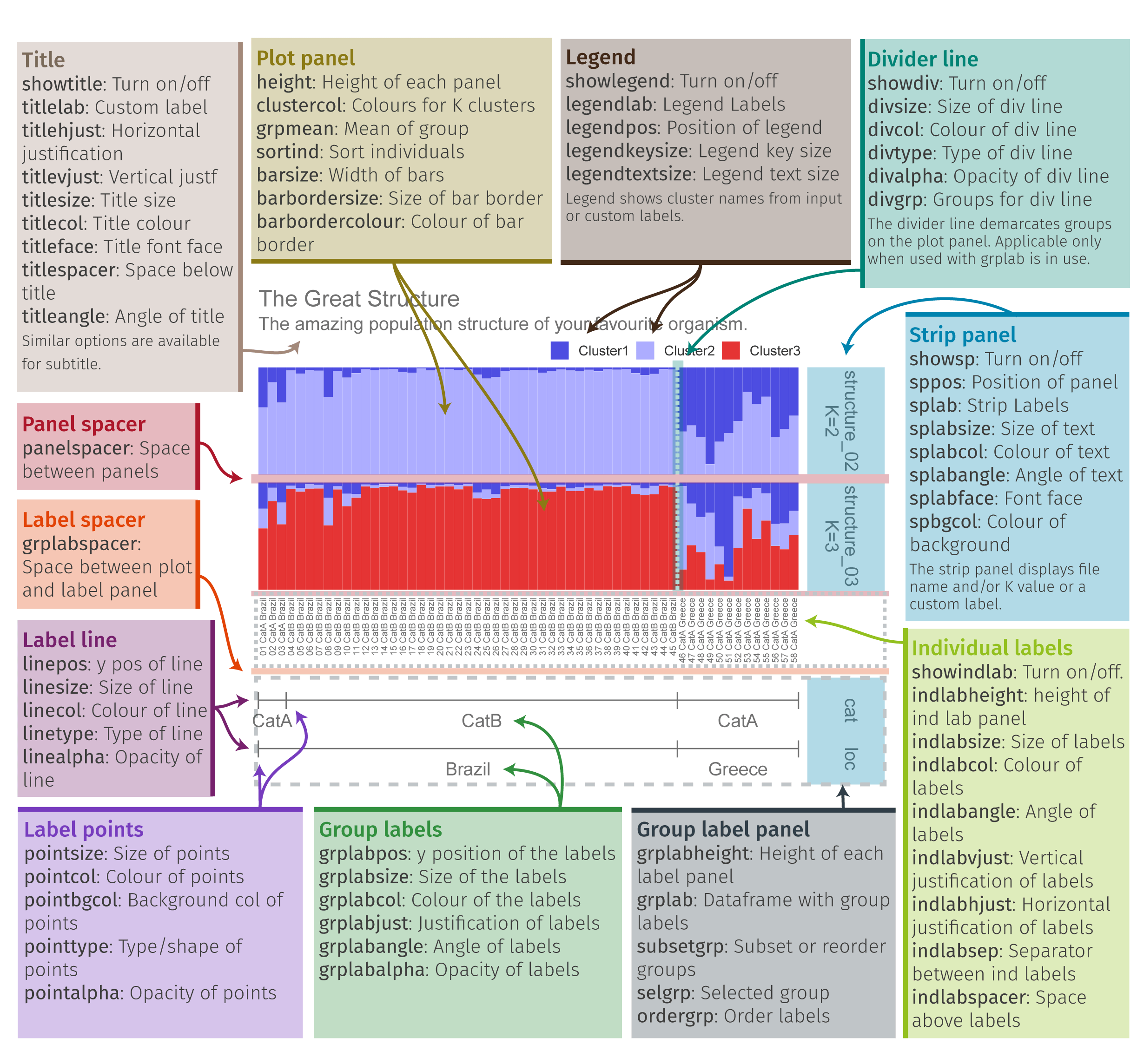
Pophelper is a really useful tool for visualizing population structure graphs. You can view the tutorial here for more information: https://www.royfrancis.com/pophelper/articles/index.html#plotting-1. We can do a lot of customization in pophelper, and this figure shows what our final result will look like!
- First we need to convert our tess3 object to a qlist for pophelper
library(pophelper) #install this package first
qlist.cukes <- readQTess3(t3list=tess3.cukes)
is.qlist(qlist=qlist.cukes)#verify format- Then we need to specify the order that we want our sites to be in and the different labels for our structure plot. The first is our population order. We want it to match the map figure and the table in the paper, so let’s order from South to North. To get the same of the sites we can do the following:
#>  [1] "OGD" "SGI" "LAS" "JER" "TOF" "CRA" "RBY" "SHE" "MAL" "QUA" "HOP" "TBL"
#> [13] "CAL" "TOL" "PRI" "LEG" "JUA" "SEL" "REN" "MAZ" "AK1" "AK2" "AK3" "AK4"
Our sites are “OGD” “SGI” “LAS” “JER” “TOF” “CRA” “RBY” “SHE” “MAL” “QUA” “HOP” “TBL” “CAL” “TOL” “PRI” “LEG” “JUA” “SEL” “REN” “MAZ” “AK1” “AK2” “AK3” “AK4”.
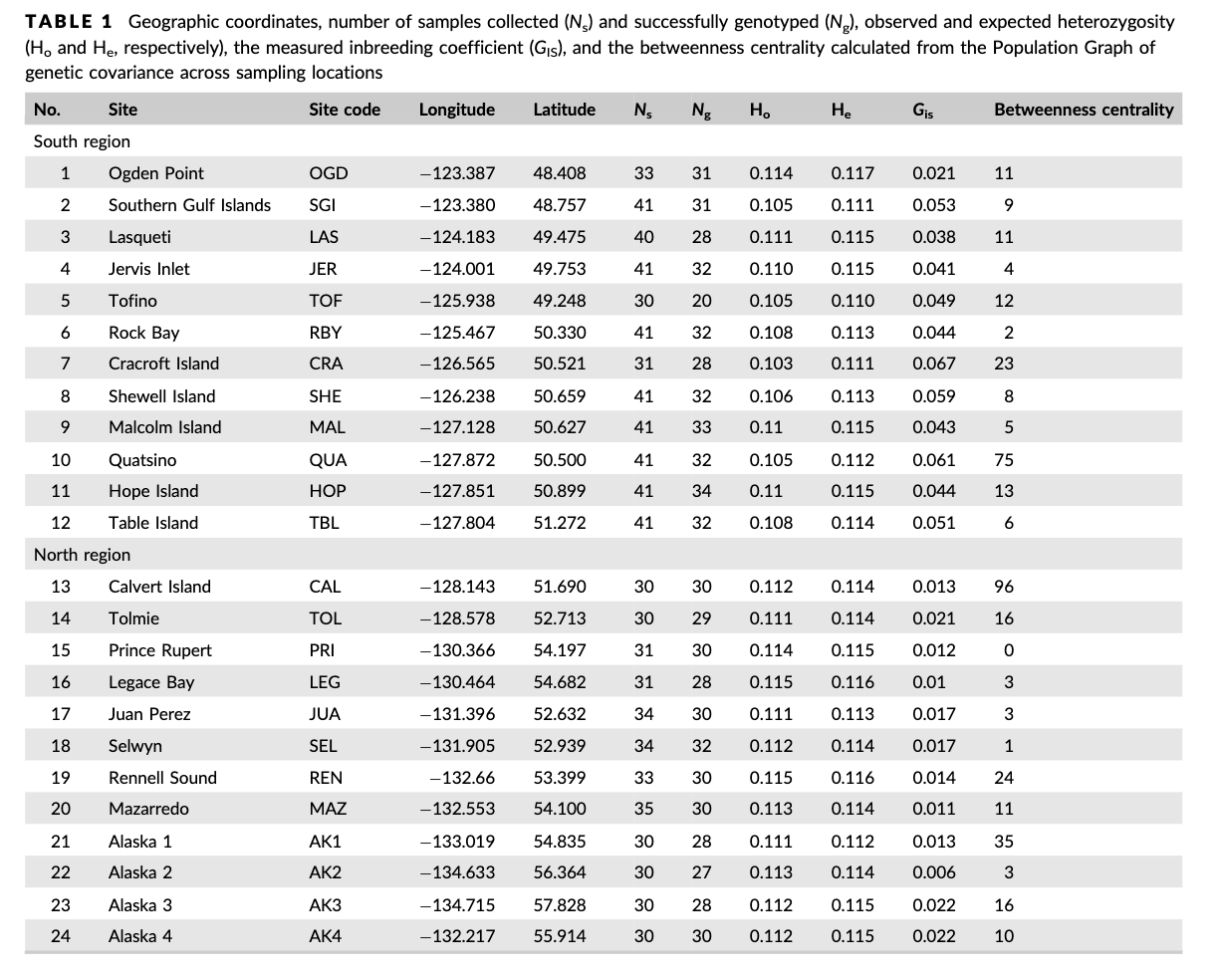
Table 1 from the paper shows the sites south to north. Luckily the dataset is already sorted appropriately, so now we can just put this into a new object!
ordered.sites=c("OGD", "SGI", "LAS" ,"JER" ,"TOF" ,"CRA" ,"RBY", "SHE", "MAL", "QUA", "HOP", "TBL", "CAL", "TOL", "PRI", "LEG", "JUA", "SEL", "REN", "MAZ", "AK1", "AK2" ,"AK3", "AK4")We also want to label our two structure plots with what K equals, so add that with the object “labels”
- Now that we have our labels we can pull the data that we want from our different files
- Now we can plot our data! To visualize we can load one final
library,
gridExtra()
library(gridExtra)
#plot samples separated by site
p<-plotQ(slist.cukes,imgoutput="join",returnplot=TRUE,exportplot=FALSE,basesize=11,
            splabsize=7,height=7,
            grplab=data.frame(SITE=labset$SITE),subsetgrp=ordered.sites,
            grplabsize=3,linesize=1,pointsize=3,splab=labels,grplabangle=0,
            grplabheight = 5)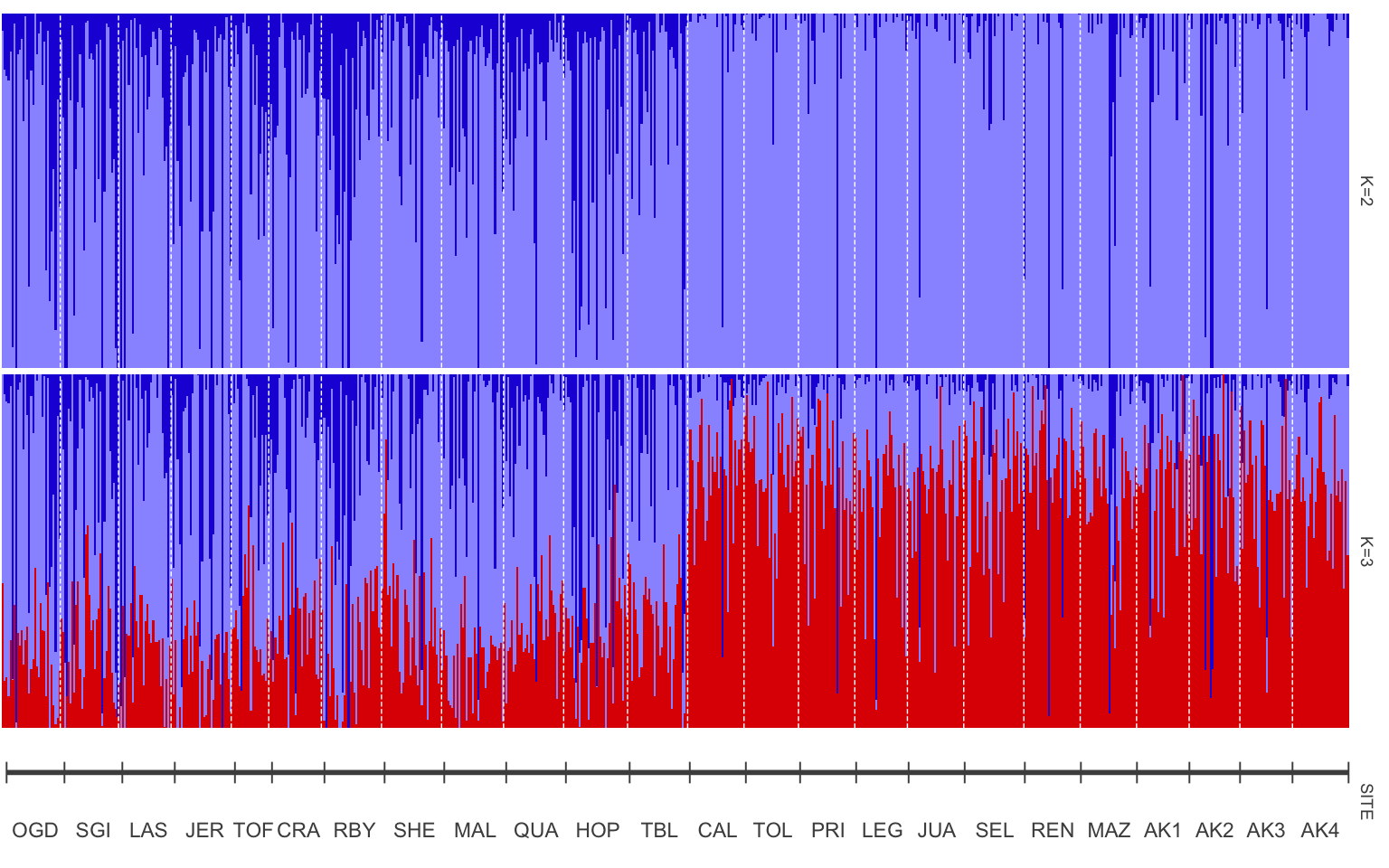
8.11 Adding more meaning to our plot
The site names may mean something if you are familiar with this area or
have read the paper, but how can we make our plot easier to understand?
One way could be to add what countries these samples were taken in so
you can get a sense of sampling area. A really useful package for data
manipulation that we haven’t used yet is called dplyr(). Remember to
install it with install.packages() and then load it with library()
The newest thing that you will see with dplyr is %>%. This is called a
pipe, and connects lines of code together.
To add a new column we will need to define what the new column will be named and then provide information to fill that column
#>
#> Attaching package: 'dplyr'
#> The following object is masked from 'package:gridExtra':
#>
#> combine#> The following objects are masked from 'package:stats':
#>
#> filter, lag#> The following objects are masked from 'package:base':
#>
#> intersect, setdiff, setequal, unionsites.data<-sites.data %>%
mutate(Country=case_when(
SITE %in% c("OGD", "SGI", "LAS" ,"JER" ,"TOF" ,"CRA" ,"RBY", "SHE", "MAL", "QUA", "HOP", "TBL", "CAL", "TOL", "PRI", "LEG", "JUA", "SEL", "REN", "MAZ") ~"British Columbia, Canada",
SITE %in% c("AK1", "AK2" ,"AK3", "AK4") ~ "Alaska, USA"))View sites.data before moving on to ensure you got the column!
Class Exercise 2
Now we can rerun some of the code we have above to remake our structure plot with “Site” and “Country” labels.
8.12 Group Work Activity- Adding even more context to our plot
The structure plot is now more organized with samples from south to north, but what if we want clear labels for how those sites split? Remember that Table 1 grouped sites by region, with Ogden Point to Table Island as the “South Region” and Calvert Island to Alaska site 4 as the “North Region”.
- Add a column for “Region” in sites.data dataset.
- Make a new structure plot with a label for
SITEandRegion. - Modify the color scheme however you’d like! View the pophelper page
for more information on how to do so. Think of how you can use color
to convey a message with your plot. A few color schemes from
pophelper()here: https://www.royfrancis.com/pophelper/articles/index.html#plotting-1
Submit your code and a photo of your structure plot to canvas.
8.13 Key Points
- Moving from terminal to R is important when working with genomic data
- Structure plots can be made using tess3r and are useful for visualizing population structure within your dataset
- Pophelper is a useful tool for customizing these structure plots
Class Exercise Solutions
Class Exercises: Solutions
Exercise 1
It looks like there might just be two clusters, since the cross-validation score drops between 1 and 2 ancestral populations. Let’s make a matrix using qmatrix for K=2 and visualize a structure plot with that. The qmatrix is a matrix of our ancestry coefficients, aka the matrix of relatedness between our samples! Our qmatrix will be called
cukes.matrix
#now the barplot
barplot(cukes.matrix, border = NA, space = 0,
        xlab = "Individuals", ylab = "Ancestry proportions",
        main = "Ancestry matrix") -> bp
#> Use CreatePalette() to define color palettes.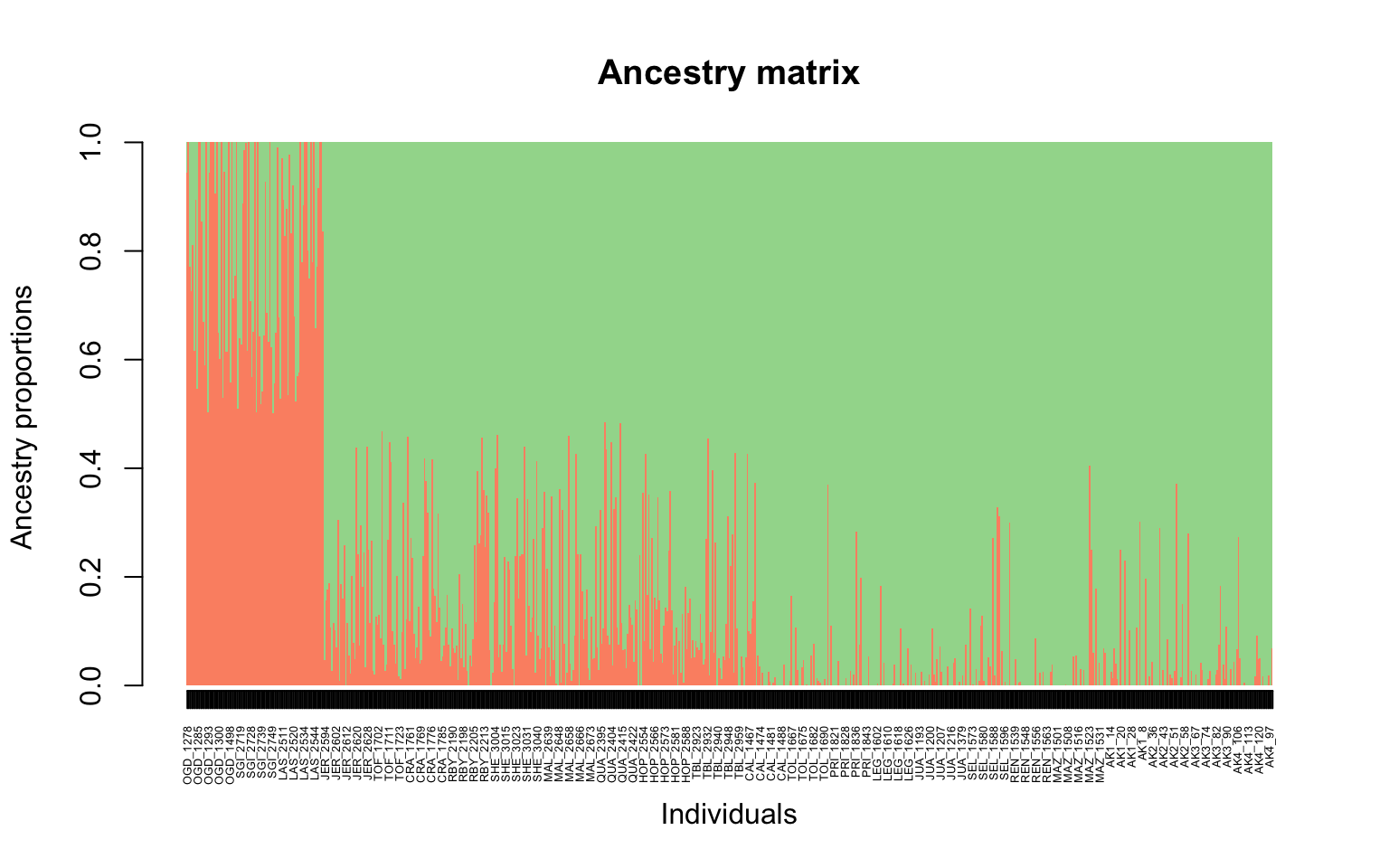
Exercise 2
structure plot with site and country labels
labset<-data.frame(sites.data)
verifyGrplab(grplab=labset[,c("SITE", "Country")]) # to make sure it is there
p2<-plotQ(slist.cukes,imgoutput="join",returnplot=TRUE,exportplot=FALSE,basesize=11,
            splabsize=7,height=7,
            grplab=labset[,c("SITE", "Country")],subsetgrp=ordered.sites,
            grplabsize=3,linesize=1,pointsize=3,splab=labels,grplabangle=0,
            grplabheight = 5)